
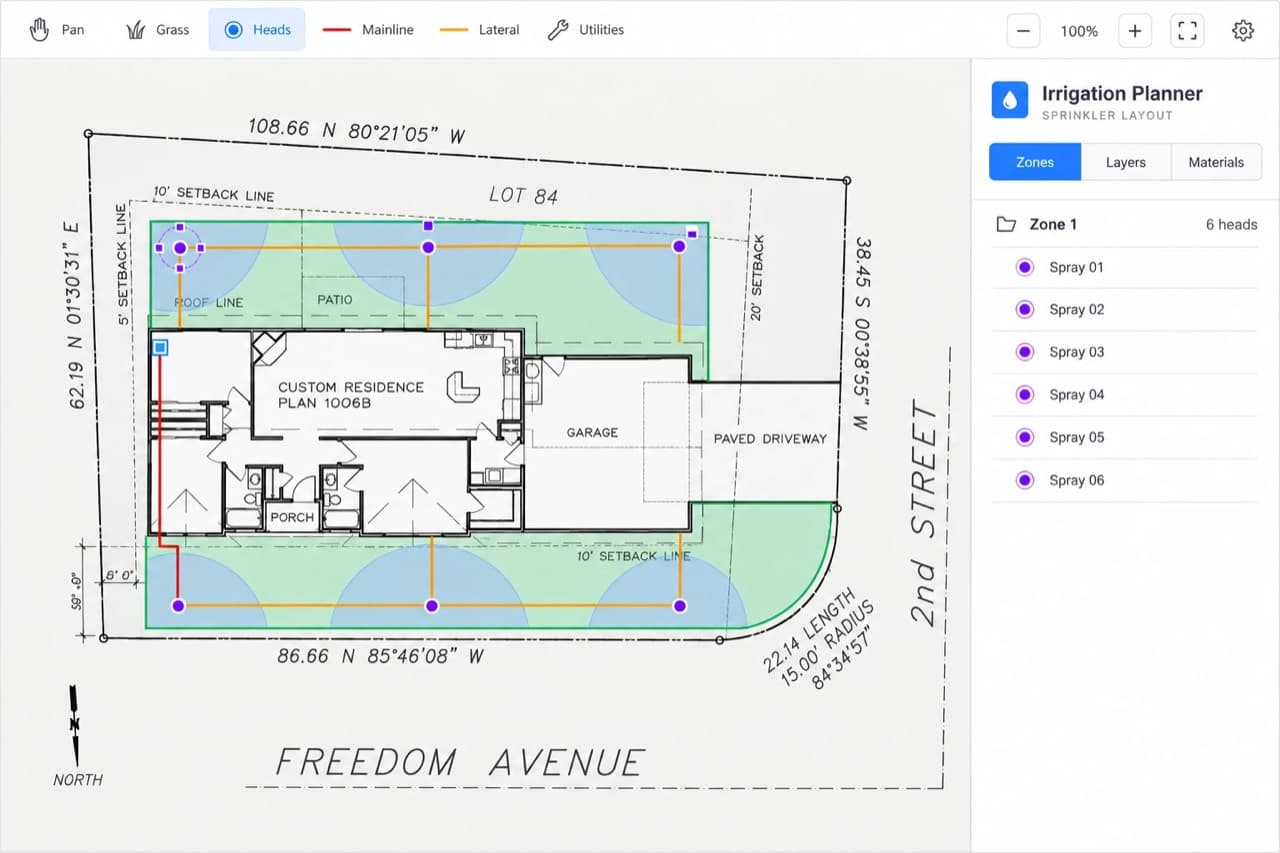
The number of heads is not a guess and it is not the area divided by some magic figure. It comes from three things: the shape of the lawn, how far each head throws water, and how much water your supply can deliver at once. This guide walks through each, then shows the layout on a real plan in the Irrigation Planner.
Start with the head, not the lawn
Every sprinkler head has a throw radius at a given pressure. Fixed spray heads typically reach 8 to 15 feet at around 30 psi. Rotors reach 20 to 40 feet and want more pressure, usually 40 to 50 psi. Pick the type that suits the lawn: sprays for narrow strips and small rectangles, rotors for open areas.
The radius sets the spacing. Sprinklers are designed for head-to-head coverage: each head throws far enough to reach the next head. Water at the edge of a spray pattern is thin, so the overlap is what makes coverage even. In practice that means spacing equal to the radius, and a little less in windy sites.
Count heads along the edges
Heads go around the perimeter of the lawn, spraying inward, with corner heads set to a quarter circle, edge heads to a half circle, and any interior heads to a full circle.
For a rectangle:
- Divide the long side by the spacing and round up. Add one. That is the number of heads along each long edge.
- Do the same for the short side.
- If the short side is longer than the spacing, you need interior rows too. Divide the short side by the spacing, round up, and subtract one for the number of interior rows.
Worked example
Take a 30 ft by 20 ft lawn with 15 ft spray heads.
- Long side: 30 ÷ 15 = 2, plus one, so 3 heads per long edge.
- Short side: 20 ÷ 15 = 1.33, rounded up to 2, plus one, so 3 heads per short edge.
- Perimeter total: 3 + 3 + 3 + 3, minus the 4 corners counted twice, is 8 heads.
- Interior rows: 20 ÷ 15 rounds up to 2, minus one, so 1 interior row of 3 heads at 15 ft spacing.
That is 11 heads for 600 square feet. If the lawn were 30 ft by 15 ft instead, the short side would equal the spacing and no interior row is needed: 6 heads, three on each long edge, which is exactly the layout on the sample plan.
Check the supply before you buy
Each head has a flow rate in gallons per minute. A 15 ft spray nozzle on a quarter circle uses around 0.4 GPM, a half circle 0.8, and a full circle 1.5 to 1.9 GPM, depending on the nozzle. Rotors use more. Add up every head in a zone and compare it with what your supply can deliver.
Measure the supply rather than assuming it. Put a 5-gallon bucket under an outside tap, open it fully, and time the fill. Divide 300 by the seconds: a bucket that fills in 30 seconds is 10 GPM. Then plan zones at about 75% of that to leave room for pressure loss in the pipe, so a 10 GPM supply gives a 7.5 GPM zone budget.
For the 11-head lawn above: 4 quarter heads at 0.4, 4 half heads at 0.8, and 3 full heads at 1.6 comes to 1.6 + 3.2 + 4.8 = 9.6 GPM. That is more than a 7.5 GPM budget, so the lawn needs two zones. The planner does this sum for you and flags a zone that is over budget.
Lay it out on your plan
Upload a site plan or a screenshot of your lot, calibrate it with one known dimension, and outline the turf. Place heads at the corners first, then along the edges at the chosen spacing, and switch each head's arc to match its position. The coverage arcs show any gaps immediately. Group the heads into zones until each zone's flow sits under your budget, and the planner produces a parts list.
Open the sample plan to see a calibrated 30 ft by 20 ft lawn ready for heads, or start your own.
Rules of thumb that usually hold
- Never mix sprays and rotors in the same zone. Their precipitation rates differ several times over.
- Shade and slope want their own zones so you can run them for different times.
- Narrow strips under 8 ft are better served by strip nozzles or drip than by sprays.
- A layout that needs a head placed off the lawn to reach a corner is a sign to reduce spacing, not to accept a dry corner.
Radius and flow depend on the specific nozzle and your actual pressure, so confirm both on the manufacturer's chart before ordering, and check local rules on backflow prevention before connecting anything to the supply.