
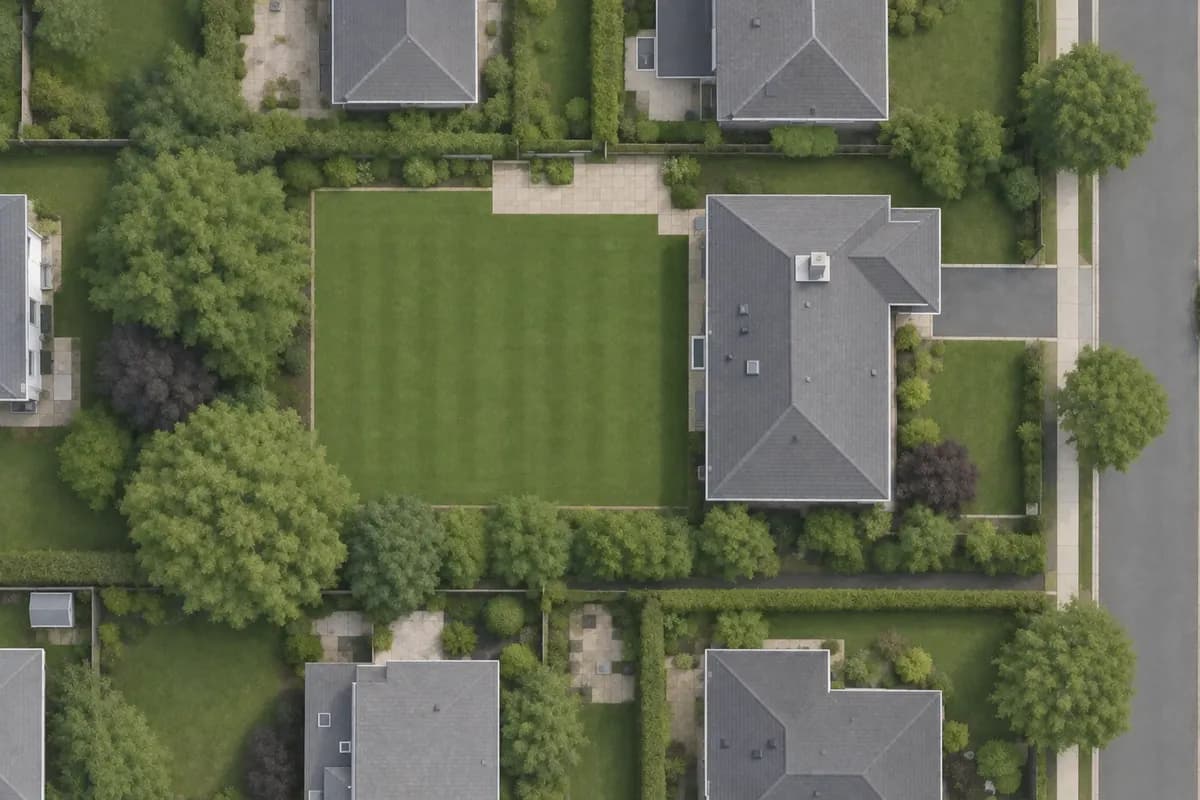
Sealer is sold by the gallon, concrete by the cubic yard, pavers by the pallet, and edging by the foot. All of them start from the same two numbers: the area of the slab and the length of its edge. You can get both from satellite imagery in a few minutes with the Google Maps Area Calculator, without walking the driveway with a tape.
Find the driveway on the map
Search your address and zoom in until the edges of the pavement are clear. Most driveways show up as a lighter shape between the street and the garage. If trees hide part of it, use what you can see and measure the hidden section on the ground later.
Switch to the satellite layer if the map is showing streets only. The measurement is the same either way, but the edges are much easier to follow on imagery.
Trace the area
Pick the area tool and click each corner of the slab. For a straight driveway that is four clicks. For a flared entrance or a curved patio, add a click every few feet along the curve. Close the shape and the calculator shows the area in square feet.
Two things to keep separate:
- Trace the driveway and the patio as separate shapes if they get different treatments. The measurements list keeps a total for you.
- Leave out the apron and sidewalk if they belong to the municipality. Sealing usually stops at the property line.
Measure the edge
Use the length tool along the sides that need edging, forms, or a border course. Skip the side against the house or garage, and skip the street end. On a typical 12 ft by 50 ft driveway, that is two long sides, or about 100 ft, not the full 124 ft perimeter.
Turn the numbers into quantities
Asphalt sealer. Most products cover somewhere between 250 and 400 square feet per gallon per coat, less on rough or porous asphalt. A 600 sq ft driveway at 300 sq ft per gallon needs 2 gallons per coat, so 4 gallons for the usual two coats. Check the coverage on the pail, since it varies more than you would expect.
Concrete. Volume is area times thickness. A 600 sq ft slab poured 4 inches thick is 600 × (4 ÷ 12) = 200 cubic feet, which is 200 ÷ 27 = 7.4 cubic yards. Order about 10% extra for uneven subgrade, so 8 yards. For a 5 inch slab the same driveway needs 9.3 yards before the allowance.
Pavers. Divide the area by the face area of one paver. A 4 in by 8 in paver covers 32 sq in, or 0.222 sq ft, so about 4.5 pavers per square foot. A 400 sq ft patio needs roughly 1,800 pavers before cuts. Add 5% for a plain running bond and 10% or more for herringbone or a curved edge.
Base and bedding. Both are also area times depth. Six inches of compacted base under 400 sq ft is 200 cubic feet, or 7.4 cubic yards. One inch of bedding sand is 33 cubic feet, about 1.2 yards.
Edging. Use the edge length directly. Add one extra stick or spike pack for cuts and corners.
Worked example
A rectangular driveway measures 12 ft by 50 ft on the map, with a small flare at the street that adds another 40 sq ft. Traced as one shape it comes to 640 sq ft. The two long sides are 100 ft of edge.
| Job | Calculation | Order |
|---|---|---|
| Two coats of sealer at 300 sq ft/gal | 640 ÷ 300 × 2 | 5 gallons |
| Replace with 4 in concrete | 640 × 0.333 ÷ 27 × 1.1 | 9 cubic yards |
| Lay 4 × 8 pavers, running bond | 640 × 4.5 × 1.05 | 3,025 pavers |
| Plastic edging | 100 ft | 5 × 20 ft sticks |
What imagery can and cannot tell you
Satellite imagery is a photograph, not a survey. Edges under trees, shadows, and image age all move the line by a foot or two, and a driveway resurfaced last year may not be in the picture yet. For sealer and base that does not matter. For a concrete order, where an extra half yard is real money, confirm the width in two places with a tape before you call it in.
Measure your driveway, or open the sample map to see a finished outline first.